Exotic physics may explain mysterious 1,000-mile Mars cloud
Summarised from 2 outlets · Updated 24 Oct, 13:57 · Archive
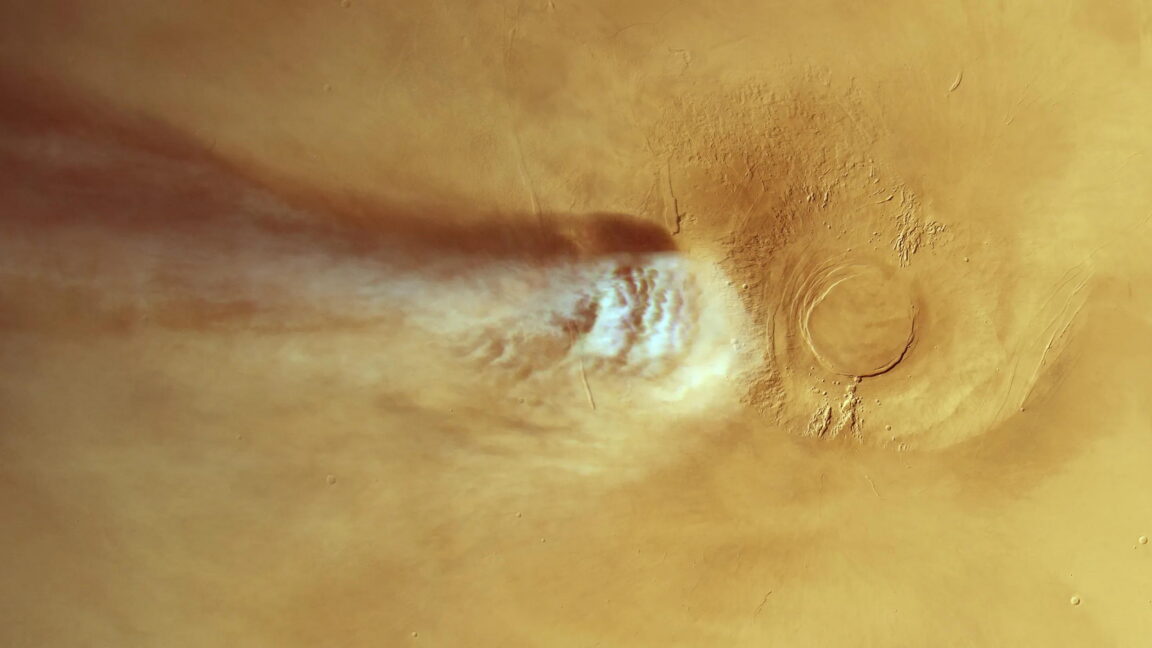
A 1,000-mile cloud on Mars may form through a physical process never directly observed before.
A mysterious 1,000-mile cloud near the Martian volcano Arsia Mons has puzzled scientists since its discovery in 2018. The cloud, known as the Arsia Mons Elongated Cloud (AMEC), appears regularly during Martian spring and summer, elongating over several hours before dissipating, then repeating the cycle for months.
Researchers have now successfully modelled the cloud's formation for the first time, according to a study published in Nature Geoscience. The model suggests AMEC forms through homogeneous nucleation, a process where water vapour transforms directly into ice crystals without requiring dust or salt particles as nucleation points. On Earth, clouds normally form when such particles provide a surface for condensation. Jorge Hernández-Bernal, lead author and planetary scientist at Sorbonne Université, explained the phenomenon as 'akin to droplets of condensation appearing in the middle of a room, rather than on a window'.
The process requires extreme conditions: a temperature drop of 30 degrees Celsius within ten minutes and high relative humidity. When wind hits the 65,000-foot-tall volcano, it creates a powerful wave that launches moist air high into the atmosphere rapidly, providing these conditions. Hernández-Bernal noted that while this physics appears in textbooks, it is 'treated as theoretical and usually thought not to happen in nature. It certainly hasn't been seen in action before'.
How it is being reported
- A 1,000-mile cloud on Mars may reveal physics never seen in natureA new model suggests Mars may host ice-forming physics never directly observed before.Ars Technica · 24 Oct, 12:50
- The ‘Exotic Physics’ Behind a Mysterious 1,000-Mile Cloud on MarsThe cloud has baffled astronomers since its discovery in 2018. Now, a new study offers a possible cause for its appearance.Wired · 23 Oct, 10:00
In this story: Mars · Arsia Mons · Jorge Hernández-Bernal · Sorbonne Université · Nature Geoscience
This summary was written by AI from the headlines and standfirsts above, and states as fact only what at least two outlets report. How we use AI · Report a problem
Comments (0)